



A week in Charleston. A long weekend in Denver. A quick escape to a lake cabin in the Ozarks.
Whatever your version of a great American getaway looks like, travel costs can climb quickly. Flights, baggage, parking, rental cars, hotels, meals and attractions can turn an affordable trip into an expensive one before you even leave home.
The good news is that many of those costs are avoidable.
You don’t necessarily need to choose a cheaper destination to spend less. In many cases, the biggest savings come from making smarter decisions during the planning process.
Recent travel-industry data continues to show that timing, flexibility and advance planning can make a meaningful difference in what travelers pay. Expedia’s 2026 Air Hacks research found that, for U.S. domestic economy flights in its data, the most affordable booking window was 15–30 days before departure, while Tuesday was the cheapest day to fly domestically on average.
This guide covers 10 practical travel hacks that can help reduce the cost of your next trip without turning your vacation into a budget exercise.
Key Takeaways
- Flight timing matters. Recent Expedia data suggests that booking and departure timing can affect domestic airfare, although there is no universal cheapest day or booking window for every route.
- Travel rewards can be valuable. A well-chosen rewards card can offset part of your airfare, hotel or other travel expenses, but only if the benefits outweigh the annual fee and you can pay the balance responsibly.
- Avoid unnecessary baggage fees. Packing lighter or using an airline card with baggage benefits can reduce one of the easiest travel expenses to overlook.
- Airport parking deserves comparison. Off-site parking, public transportation and rideshares can sometimes cost less than parking directly at the terminal.
- Flexibility can save money. Moving a flight by a day or two can sometimes produce meaningful savings.
- Food doesn’t have to be expensive. Mixing restaurant meals with groceries, markets and casual local spots can reduce daily spending.
- Airport rental cars aren’t always the cheapest option. Compare airport and neighborhood locations before booking.
- City passes can make sense for attraction-heavy trips. The key is to calculate the cost against the attractions you actually plan to visit.
- Location matters for hotels. Staying near public transportation but outside the most expensive tourist blocks can sometimes lower accommodation costs.
- Book popular attractions ahead of time. Advance reservations can help you avoid sold-out time slots during busy periods.
Table of Contents
- Book Flights Based on Data, Not Last-Minute Hopes
- Use Credit Card Rewards Strategically
- Avoid Unnecessary Checked Bag Fees
- Compare Airport Parking Options
- Travel on Less Expensive Days When Possible
- Eat Like a Local
- Compare Airport and Off-Airport Rental Cars
- Calculate Whether a City Pass Is Worth It
- Stay Near the Tourist Zone Instead of Inside It
- Book Popular Attractions in Advance
1. Book Flights Based on Data, Not Last-Minute Hopes
One of the biggest mistakes travelers make is assuming that waiting until the last minute will automatically produce a cheaper flight.
That strategy can work occasionally, but it isn’t something travelers should rely on.
Expedia’s 2026 Air Hacks research analyzed millions of data points and found that, for U.S. domestic economy flights in its analysis, travelers saw the lowest average fares when booking 15–30 days before departure. The same report found that Tuesday departures were cheaper on average than Sunday departures for U.S. domestic flights.
That doesn’t mean every flight should be booked exactly 15, 20 or 30 days ahead. A New York-to-Los Angeles flight in October can behave very differently from a flight to a popular beach destination during a holiday weekend.
The better strategy is to use historical data as a guide while monitoring the specific route you want.
A smarter flight-booking strategy
Start by checking the route several weeks or months before your trip.
Use Google Flights to monitor price changes and compare nearby airports and dates. If your schedule allows flexibility, check several departure dates instead of searching for only one exact day.
You can also compare:
- Different departure airports
- Different return dates
- Morning versus afternoon flights
- Nonstop versus connecting flights
- Weekday versus weekend departures
- Nearby airports at your destination
If you’re still researching where to go, you can also explore QayQay’s guide to travel destinations travelers are suddenly obsessed with in 2026 for destination inspiration.
The important point is not to obsess over finding the absolute lowest fare.
If you find a price that fits your budget and the historical pricing looks reasonable, waiting for another small drop may not be worth the risk.

2. Use Credit Card Rewards Strategically
Travel rewards cards can be one of the most useful tools for reducing travel costs, especially for people who already pay for flights, hotels and everyday expenses with a credit card.
But there is an important rule: never spend money you wouldn’t otherwise spend just to earn points.
A large sign-up bonus can be valuable, but only if you can meet the spending requirement without carrying expensive credit-card debt.
Travel cards generally fall into two broad categories.
Airline and hotel cards
These cards are connected to a particular airline or hotel program. Depending on the card and the program, benefits can include:
- Free checked bags
- Priority boarding
- Hotel benefits
- Loyalty points or miles
- Annual travel credits
- Airport lounge access
Flexible travel rewards cards
Flexible programs can allow cardholders to redeem points through a travel portal or transfer them to participating airline and hotel loyalty programs.
That flexibility can be useful when you don’t want to be tied to one airline.
What to calculate before applying
Don’t look only at the welcome bonus.
Compare:
- Annual fee
- Welcome bonus
- Required spending
- Travel credits
- Baggage benefits
- Foreign transaction fees
- Redemption options
- Transfer partners
- Lounge benefits
- Expiration or account requirements
A card with a large bonus isn’t automatically a good deal if the annual fee is high and you don’t use the benefits.
And if you don’t travel frequently, a simple cash-back card may be more practical.
3. Avoid Unnecessary Checked Bag Fees
Baggage fees are one of those travel costs that can look small individually but become expensive for families and frequent travelers.
Airlines have different baggage rules, and fees vary according to the airline, route, fare type, loyalty status and whether the bag is paid for in advance.
The U.S. Department of Transportation provides consumer information about airline fees and baggage disclosures, but travelers should still check the operating airline’s current policy before departure.
You can review the latest official information through U.S. Department of Transportation — Aviation Consumer Protection.
Ways to reduce baggage costs
Pack carry-on only when practical.
For a short trip, a well-organized carry-on can eliminate the need for a checked bag altogether.
Check whether your credit card includes baggage benefits.
Some airline-branded cards provide free checked bags for eligible cardholders and, depending on the program, other passengers on the same reservation.
Compare the total fare, not just the ticket price.
A cheap basic fare can become less attractive once you add baggage, seat selection and other extras.
Check the airline’s current rules.
Don’t assume that the policy you used on your last trip is still the same.

4. Compare Airport Parking Options
Airport parking is easy to ignore when you’re focused on finding a cheap flight.
But if you’re leaving your car at the airport for several days, parking can become a significant part of your trip budget.
Before choosing terminal parking, compare:
- Official airport parking
- Off-site airport parking
- Hotel park-and-fly packages
- Public transportation
- Rideshare services
- Getting dropped off by family or friends
Off-site parking can sometimes be less expensive than parking directly at the terminal, especially for longer trips.
Some hotels also sell park-and-fly packages that combine one night’s accommodation with parking for the duration of a trip. These deals aren’t always cheaper, so compare the total package price with the cost of parking separately.
The simple calculation
Don’t ask:
“What’s the cheapest parking rate?”
Ask:
“What’s the cheapest total transportation cost?”
For example, an off-site lot may advertise a lower daily price but require a rideshare to reach it. A slightly more expensive lot with a free airport shuttle could ultimately be cheaper.

5. Travel on Less Expensive Days When Possible
Flexibility can be one of the easiest ways to lower the cost of a trip.
If you’re able to move your departure or return by one day, check the price difference before finalizing your itinerary.
Expedia’s 2026 U.S. Air Hacks research found that Tuesday departures were cheaper on average than Sunday departures in its U.S. domestic data.
But don’t treat that as a universal rule.
Flight prices depend on the route, season, airport, airline, demand and many other factors.
Try a flexible-date search
When looking for flights, check:
- Tuesday
- Wednesday
- Thursday
- Saturday
- Sunday
- One day earlier
- One day later
You may discover that changing your itinerary by 24 hours saves more than any coupon or discount code.
The same principle can apply to hotels.
A property that costs more on Friday and Saturday may be considerably cheaper on Sunday through Thursday, particularly in destinations dominated by weekend leisure travel.
Make flexibility work for you
If you have a four-day trip planned from Friday to Monday, search Thursday to Sunday and Saturday to Tuesday as well.
You don’t need to completely change your vacation.
Sometimes one small calendar adjustment is enough.
6. Eat Like a Local
Food can quietly become one of the largest expenses on vacation.
Three restaurant meals a day for two people can add up quickly, especially in major tourist destinations.
The solution isn’t to stop enjoying restaurants.
Instead, mix restaurant meals with cheaper alternatives.
Start with a local grocery store
After arriving, find a nearby supermarket, bakery or market.
Buy items such as:
- Breakfast foods
- Fruit
- Snacks
- Drinks
- Sandwich ingredients
- Local specialties
- Picnic supplies
This gives you an inexpensive meal option while still allowing you to explore local food.
Eat your biggest restaurant meal at lunch
Some restaurants offer lunch menus or smaller portions at lower prices than their dinner offerings.
If there’s a restaurant you’ve been wanting to try, check whether lunch offers the same experience for less.
Don’t automatically order three courses
Travelers sometimes order more food than they would at home simply because they’re on vacation.
Sharing an appetizer or entrée can be a practical option when portions are large.
Ask locals where they eat
Hotel staff, shop owners and residents can often point you toward restaurants outside the main tourist streets.
The goal isn’t to avoid spending money.
It’s to spend it where it provides more value.

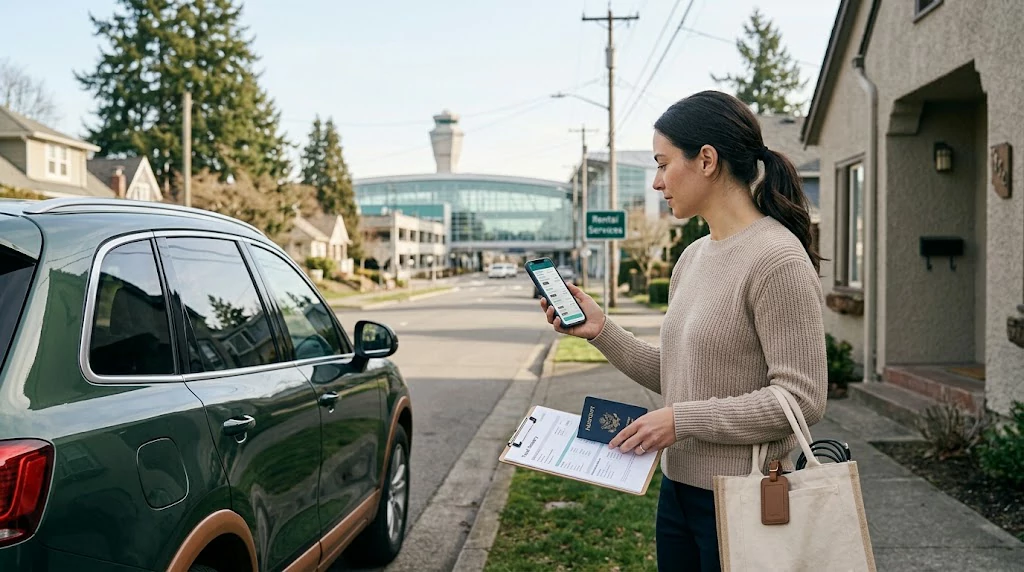
7. Compare Airport and Off-Airport Rental Cars
Airport rental counters are convenient, but convenience isn’t always the cheapest option.
Airport locations can have additional fees or different pricing structures, so compare the exact same vehicle and rental period at a nearby neighborhood branch.
Before booking, compare these numbers
- Airport rental price
- Neighborhood rental price
- Rideshare or transit cost to the neighborhood branch
- Fuel cost
- Insurance
- Additional-driver fees
- Taxes and facility charges
Then compare the final total, not the headline daily rate.
Check membership discounts
AAA offers travel-related discounts and rental-car benefits through participating partners. Availability and terms vary, so check the current offer before booking.
You can review available options through AAA Travel.
Don’t automatically buy every add-on
Rental counters commonly offer extras such as:
- GPS
- Prepaid fuel
- Additional insurance
- Roadside assistance
- Satellite radio
- Toll packages
Some may be useful. Others may duplicate coverage or services you already have.
Check your personal auto insurance and credit-card benefits before paying for duplicate coverage.
And if you return the vehicle with less fuel than required, you may pay a premium for the rental company’s refueling service.
8. Calculate Whether a City Pass Is Worth It
City attraction passes can be a great value—but only when the attractions you want are actually included.
CityPASS currently advertises savings of up to 50% or more on some participating products, depending on the destination and product. For example, the 2026 New York CityPASS advertises savings of up to 51% off regular admission.
The mistake is buying a pass simply because it says “save up to 50%.”
Instead, do the math first.
Ask yourself:
- Which attractions do I actually want to visit?
- How much would those individual tickets cost?
- Does the pass include the attractions I care about?
- Do I need reservations?
- How many days do I have?
- Can I realistically visit enough attractions to make the pass worthwhile?
For example, if a pass includes five attractions but you only plan to visit two, the advertised maximum savings may not apply to your trip.
On the other hand, if you already plan to visit several expensive attractions, a bundled pass can reduce the total admission cost.
You can check current products and destination-specific savings on CityPASS.

9. Stay Near the Tourist Zone Instead of Inside It
You don’t always need to stay directly in the most famous neighborhood.
A hotel or vacation rental a few subway stops away—or a short walk outside the main tourist district—can sometimes offer better rates.
The key is finding the balance between price and transportation.
A hotel that saves $40 per night isn’t actually a bargain if you spend $30 each day getting to the attractions.
Look for:
- Hotels near subway or light-rail stations
- Neighborhoods adjacent to the tourist center
- Areas with restaurants and grocery stores nearby
- Properties within walking distance of public transportation
- Accommodations with kitchens for longer stays
For longer stays, check whether the property offers weekly or monthly discounts.
Airbnb supports weekly discounts for stays of seven or more nights and monthly discounts for stays of 28 or more nights, although the actual discount varies by listing.
You can review the current Airbnb information about weekly and monthly stay discounts.
The important word is “varies.”
Don’t assume that every long stay will automatically be 20% or 40% cheaper. Compare the final price, including cleaning fees, service fees and taxes.
10. Book Popular Attractions in Advance
Some travel expenses aren’t about finding a discount.
They’re about avoiding a costly mistake.
Popular attractions can have limited timed-entry availability, especially during holidays and peak travel periods.
Booking ahead can help you avoid arriving at a sold-out attraction or having to purchase a more expensive alternative at the last minute.
Consider booking these in advance:
- Observation decks
- Popular museums
- Guided tours
- Major landmarks
- Popular restaurants
- Intercity trains
- Special events
But don’t pre-book everything simply because you can.
Some activities are better left flexible.
The goal is to reserve the things that are likely to sell out while keeping enough room in your itinerary for spontaneous discoveries.
Frequently Asked Questions
What is the single best travel hack to save money?
There isn’t one universal hack that works best for every traveler.
For flights, flexibility around booking dates and departure dates can make a significant difference. Expedia’s 2026 data found that the 15–30-day booking window was the most affordable for U.S. domestic economy flights in its dataset, while Tuesday was the cheapest domestic departure day on average.
For the rest of the trip, compare the total cost of transportation, accommodation, food and attractions instead of focusing on one expense.
Are last-minute flight deals actually real?
Sometimes, but travelers shouldn’t build a budget around finding one.
Airlines price flights dynamically, and fares can move in either direction depending on demand, inventory and route.
For that reason, waiting until the last minute isn’t a reliable money-saving strategy.
Instead, monitor your route, compare flexible dates and book when you find a fare that fits your budget.
How much can a travel credit card save me?
It depends entirely on the card, the sign-up offer, your spending and how you redeem the rewards.
A card can provide value through a welcome bonus, travel credits, free baggage or other benefits.
But annual fees matter.
Before applying, calculate:
Value of rewards + useful benefits − annual fee = potential net value
And always avoid carrying a credit-card balance just to earn points.
Do I really need to pay for checked bags?
Only if you need to check a bag.
If you can travel with a carry-on, you may avoid the checked-bag charge altogether.
If you do need to check luggage, look at your airline’s current baggage policy and check whether your fare, elite status or credit card includes a baggage allowance.
Because baggage policies change, verify the rules directly with your airline before departure. You can also review the latest consumer information from the U.S. Department of Transportation.
What’s the cheapest way to get from the airport to my hotel?
It depends on the destination.
Public transportation can be the least expensive option where a convenient airport rail or bus connection exists.
Rideshares can make more sense for travelers sharing the cost.
A rental car may be unnecessary if you’re staying in a walkable city with good public transportation.
Always compare the complete cost—including parking, fuel and airport fees—not just the initial rental price.
Is it worth buying a city pass for attractions?
It can be.
The key is to calculate the pass against the exact attractions you plan to visit.
CityPASS currently advertises savings of up to 50% or more on some participating products, but the actual savings vary by destination and itinerary.
If you’re visiting several expensive attractions included in the pass, the math may work in your favor.
If your itinerary is mostly free attractions, individual tickets may make more sense.
How can I save money on food without eating every meal from a grocery store?
Try replacing just one meal a day.
Breakfast is often the easiest option.
Buy coffee, fruit, yogurt, pastries or other breakfast items from a grocery store or local bakery, then save your restaurant budget for lunch or dinner.
You can also look for lunch specials, local markets and restaurants outside the main tourist streets.
That way, you’re reducing costs without giving up the food experience that makes travel enjoyable.
Final Thoughts
Saving money on travel doesn’t mean choosing the cheapest hotel, eating instant noodles or avoiding everything that makes a vacation memorable.
The biggest opportunity is usually making several small decisions correctly.
Compare flight dates.
Check baggage rules.
Look at off-airport parking.
Compare rental locations.
Use rewards strategically.
Stay near public transportation.
Mix restaurants with local markets.
Calculate attraction passes before buying them.
And book popular activities before they sell out.
One decision may save only $20.
Another might save $100.
But when you combine several smart choices across a week-long trip, the difference can become substantial.
The best travel budget isn’t necessarily the one with the lowest spending.
It’s the one where your money goes toward the experiences you actually care about.
If you’re interested in how technology is changing the way people plan vacations, see QayQay’s guide to How AI Is Changing Travel Planning in 2026.
Sources & Further Reading
U.S. Department of Transportation — Aviation Consumer Protection
Official information about airline consumer rights, baggage fees and air-travel regulations.
U.S. Department of Transportation
Expedia — 2026 Air Hacks Report
Recent analysis of U.S. domestic airfare booking and departure patterns based on millions of Expedia data points.
Expedia 2026 Air Hacks Report
AAA Travel
Travel resources and current information about participating rental-car and travel benefits.
AAA Travel
CityPASS
Official information about attraction passes, destinations and current savings.
CityPASS
Airbnb
Official information about weekly and monthly discounts for eligible longer stays.
Airbnb weekly and monthly discounts