


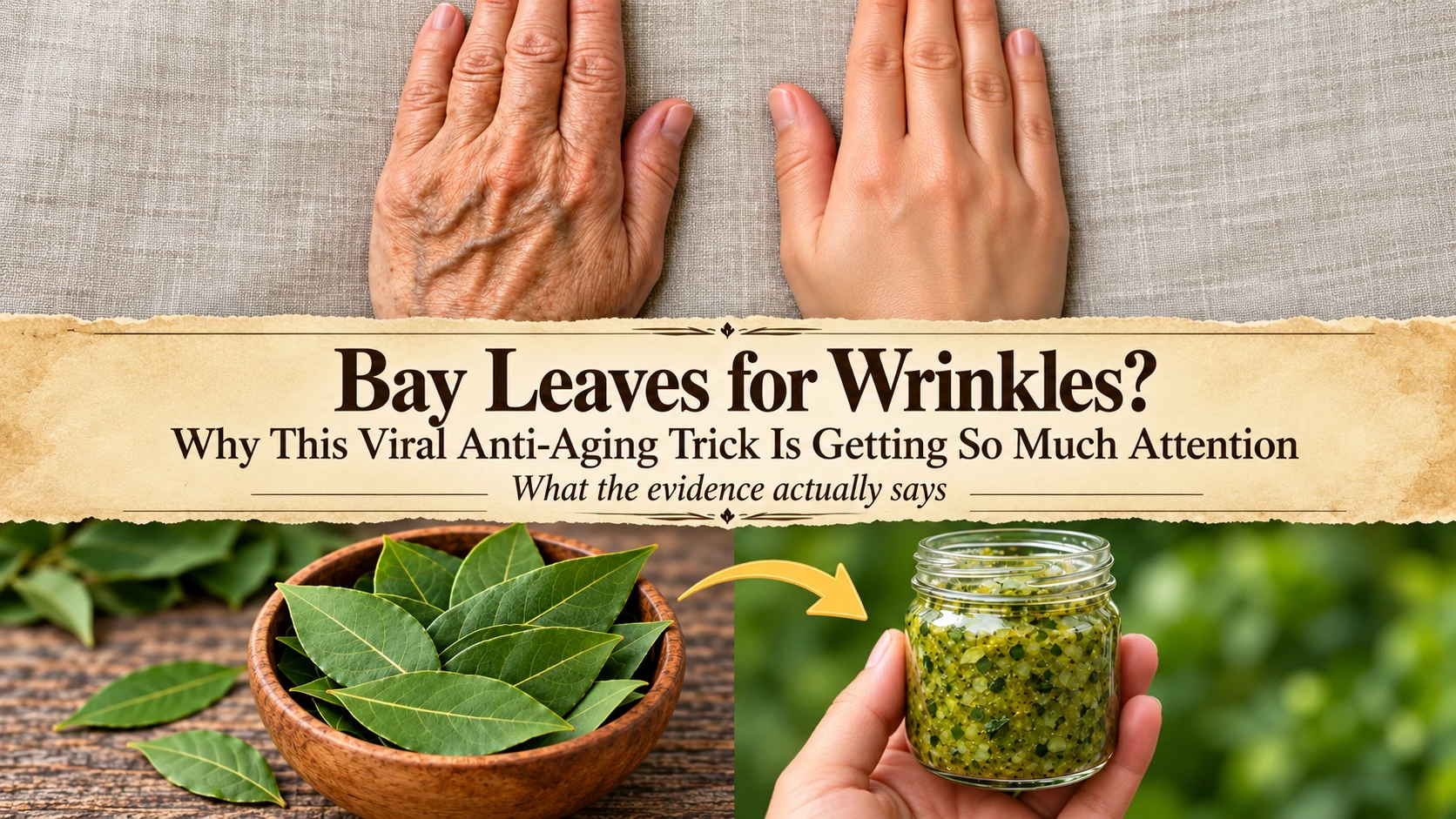
Bay leaves for wrinkles have become a viral beauty topic, with social-media posts claiming that homemade bay-leaf mixtures can smooth fine lines, tighten skin, or even rival treatments such as Botox or collagen-based products.
Those claims are attention-grabbing, but they go far beyond what current evidence supports. Bay leaves contain aromatic plant compounds, and bay leaf oil is used in some cosmetic or fragrance formulations, but that does not mean applying bay leaves to the face can erase wrinkles.
Dermatology guidance is much more cautious. The American Academy of Dermatology recommends proven approaches such as daily broad-spectrum sunscreen, moisturizers, retinoids when appropriate, and professional procedures for people seeking more significant wrinkle reduction.
That does not mean the bay-leaf trend is completely meaningless. It does mean the difference between a pleasant DIY skincare ritual and a clinically effective wrinkle treatment needs to be clear.
Why Bay Leaves for Wrinkles Became So Popular
DIY beauty remedies spread quickly because they are inexpensive, easy to demonstrate, and visually satisfying.
Bay leaves fit that formula perfectly. They are familiar, easy to find, and often associated with natural remedies. Videos commonly show leaves being boiled, steeped, blended, or mixed with other kitchen ingredients before being applied to the skin.
The appeal is obvious:
- the ingredient is inexpensive
- the preparation looks simple
- the ritual feels “natural”
- before-and-after claims are easy to dramatize
- viewers may already associate herbs with health benefits
However, popularity is not the same as evidence.
The fact that a plant contains antioxidants or aromatic compounds does not automatically mean it can penetrate skin deeply enough to reverse established wrinkles.
That distinction is especially important when viral posts compare bay leaves with Botox.
Botulinum toxin works through a specific biological mechanism involving muscle activity. Bay leaves do not work through the same mechanism, and there is no credible basis for calling them “stronger than Botox.” The American Academy of Dermatology includes botulinum toxin among established cosmetic treatments for wrinkles.
For more information, read our guide to: https://qayqay.com/maureen-vanderslice-love-story/
What Bay Leaves Actually Contain
Bay leaves come from Laurus nobilis, the culinary bay tree.
They contain volatile aromatic compounds and plant chemicals that contribute to their distinctive smell and flavor. Bay leaf oil is also recognized as a fragrance-related substance in cosmetic contexts. PubChem identifies bay leaf oil as the essential oil of Laurus nobilis and notes that fragrance-allergen considerations can apply.
That matters because “natural” does not automatically mean “non-irritating.”
Plant-derived oils and extracts can contain compounds that trigger irritation or allergic reactions in some people, especially when used in concentrated form.
There is also a major difference between:
- eating bay leaves as a culinary ingredient
- using a diluted cosmetic formulation containing bay-derived compounds
- applying homemade concentrated extracts directly to facial skin
Those are not equivalent exposures.
Can Bay Leaves Really Remove Wrinkles?
There is currently no strong clinical evidence showing that homemade bay-leaf preparations can eliminate wrinkles or fine lines.
That is the key point.
Wrinkles form through several overlapping processes, including:
- repeated facial movement
- age-related collagen and elastin changes
- ultraviolet exposure
- smoking
- environmental stress
- skin dryness
- genetic factors
A simple plant infusion is unlikely to address all of those mechanisms.
At most, a homemade liquid may temporarily hydrate the skin surface, especially if it is combined with moisturizing ingredients. Better hydration can sometimes make fine lines appear less noticeable for a short period.
The American Academy of Dermatology notes that moisturizers can temporarily plump the skin and make some fine lines look less obvious.
That is very different from permanently removing wrinkles.

Why the Botox Comparison Is Misleading
This is where viral claims become especially problematic.
Botulinum toxin injections reduce certain wrinkles by temporarily relaxing targeted muscles. They are typically used for expression lines such as forehead lines, frown lines, and crow’s feet.
Bay leaves do not have evidence showing that they produce a comparable effect.
Therefore, a claim such as “bay leaves are more powerful than Botox” is not just exaggerated; it compares two completely different things without evidence.
The same problem applies to collagen claims.
Collagen is an important structural protein in skin, but simply applying an herb to the surface does not mean the skin suddenly produces enough new collagen to erase visible wrinkles.
Some proven topical ingredients, such as retinoids, have evidence supporting improvement in fine lines and skin texture. The American Academy of Dermatology specifically notes that retinoids can help with mild fine lines and wrinkles.
What Actually Has Better Evidence for Wrinkles
If the goal is to reduce visible fine lines, several approaches have substantially stronger evidence than bay leaves.
Daily sunscreen
Ultraviolet exposure contributes significantly to premature skin aging.
The AAD recommends broad-spectrum sunscreen with SPF 30 or higher as part of a strategy to reduce premature skin aging and protect against UV damage.
Moisturizer
Moisturizers trap water in the skin and can make fine lines appear temporarily softer.
This is one of the simplest and safest first steps for many people.
Retinoids
Topical retinoids and retinol are among the better-studied skincare ingredients for fine lines, texture, and photoaging.
They can also cause irritation, especially when first introduced, so gradual use and professional guidance can be useful.
Professional treatments
Depending on the type and depth of wrinkles, dermatologists may use:
- botulinum toxin
- fillers
- chemical peels
- laser resurfacing
- radiofrequency
- other procedures
The choice depends on skin type, wrinkle pattern, goals, medical history, and budget.
Are Bay Leaves Safe to Put on the Face?
Not necessarily for everyone.
The main concern is irritation.
Bay leaf oil can contain fragrance-related compounds, and fragrance ingredients are a common trigger for contact reactions in susceptible skin. PubChem lists bay leaf oil in relation to fragrance-allergen regulatory considerations.
Homemade mixtures are especially unpredictable because concentration is not standardized.
A boiled infusion may be relatively weak, while essential oil or heavily concentrated extract may be much stronger.
People with:
- sensitive skin
- eczema
- rosacea
- fragrance allergy
- damaged skin barrier
should be especially cautious with DIY botanical products.
The AAD also recommends patch testing new skincare products before wider use.
What About Bay Leaf Water?
Bay leaf water is usually made by steeping or boiling bay leaves and allowing the liquid to cool.
From a skincare perspective, the main potential effect is likely hydration or a mild sensory experience rather than clinically meaningful wrinkle removal.
There are also practical issues with homemade water-based mixtures.
Without preservatives, they can become contaminated over time.
Therefore:
- make only a small amount
- avoid storing it for long periods
- do not apply it to broken or irritated skin
- stop immediately if burning, redness, or itching develops
- avoid the eye area
If someone still wants to experiment, a mild, short-contact approach is generally more sensible than leaving a concentrated botanical mixture on the face overnight.
Can Bay Leaves Boost Collagen?
There is not good evidence showing that topical bay-leaf remedies significantly increase human skin collagen in a way that visibly reverses wrinkles.
This is another area where online claims often jump from laboratory chemistry to human skincare results.
A plant may contain antioxidant compounds in a lab setting, but that does not automatically prove that:
- the compounds penetrate human skin effectively
- they reach the correct skin layer
- they remain active there
- they stimulate meaningful collagen production
- they produce visible wrinkle reduction
All of those steps matter.
For more information, read our guide to: https://qayqay.com/maureen-vanderslice-love-story/
Why Viral Before-and-After Photos Can Be Misleading
Skincare before-and-after content is easy to manipulate unintentionally or intentionally.
Changes in:
- lighting
- camera angle
- facial expression
- hydration
- makeup
- image sharpness
- distance from the camera
can dramatically change how fine lines look.
A person who applies a hydrating mixture may also temporarily look smoother simply because the skin surface contains more water.
That does not prove collagen regeneration.
The same caution applies to videos where someone applies a product and shows “results” minutes later.
True remodeling of skin structure generally does not happen instantly.
A Safer Way to Approach Viral Skincare Trends
Instead of asking whether a viral remedy is “natural,” ask better questions:
- Is there human clinical evidence?
- What concentration was studied?
- Was the product tested on facial skin?
- Are there known irritation risks?
- Is the claim realistic?
- Does the ingredient work through a plausible mechanism?
- Is the result temporary or structural?
These questions help separate curiosity from marketing.
They also make it easier to enjoy beauty trends without expecting impossible results.
Frequently Asked Questions About Bay Leaves for Wrinkles
Do bay leaves remove wrinkles?
There is no strong clinical evidence showing that bay leaves can remove wrinkles.
Can bay leaves replace Botox?
No credible evidence supports that claim. Botox and similar botulinum toxin treatments work through a specific muscle-relaxing mechanism that bay leaves do not replicate.
Can bay leaves increase collagen?
There is not good evidence showing that homemade topical bay-leaf preparations significantly boost human skin collagen.
Can bay leaf water tighten skin?
It may temporarily make skin feel refreshed or hydrated, but there is no strong evidence that it permanently tightens skin.
Can bay leaf oil irritate skin?
Yes. Bay leaf oil contains fragrance-related compounds and may irritate sensitive skin.
What works better for fine lines?
Evidence-backed options include sunscreen, moisturizers, retinoids, and dermatologist-performed procedures depending on the type of wrinkle.
Should I patch test bay leaf products?
Yes. Patch testing is a sensible precaution with new skincare products, especially botanical or fragranced ones.
Final Thoughts
The viral interest in bay leaves for wrinkles is understandable. The ingredient is inexpensive, familiar, and easy to turn into a DIY beauty ritual.
What is not supported is the claim that bay leaves erase wrinkles, rebuild collagen dramatically, or outperform Botox.
At best, a mild bay-leaf preparation may provide a temporary hydrating or refreshing effect. At worst, concentrated preparations may irritate sensitive skin.
For people who want meaningful wrinkle prevention or treatment, the evidence is much stronger for daily sun protection, moisturizers, retinoids when appropriate, and professional dermatologic options.
Natural ingredients can be enjoyable. They just should not be presented as proven substitutes for treatments they have never been shown to match.